Noise-induced hearing loss (NIHL) is one of the most common — and most preventable — occupational injuries worldwide. According to the World Health Organization, over 1.1 billion young people are at risk of hearing loss due to unsafe sound practices, while an estimated 430 million people already live with disabling hearing loss. In the workplace, the numbers are equally alarming: the U.S. Bureau of Labor Statistics reports that occupational hearing loss accounts for roughly 14% of all occupational illnesses, and OSHA estimates that approximately 22 million American workers are exposed to hazardous noise levels every year.
The consequences extend far beyond the ear. Untreated hearing loss is associated with cognitive decline, social isolation, depression, and reduced workplace productivity. For employers, it translates into workers' compensation claims, increased absenteeism, and regulatory penalties. The economic burden is staggering — the CDC estimates that occupational hearing loss costs the U.S. economy over $242 million annually in workers' compensation alone.
The good news? Hearing loss from noise exposure is entirely preventable with the right hearing protection. This comprehensive guide covers everything safety managers, procurement professionals, and distributors need to know — from understanding noise levels and choosing the right protectors, to certifications, proper fit, and sourcing strategies.
Understanding Noise Levels
The Decibel Scale
Sound intensity is measured in decibels (dB), a logarithmic unit. This is critical to understand: the decibel scale is not linear. An increase of just 3 dB represents a doubling of sound energy. That means a noise source at 88 dB is twice as intense as one at 85 dB, even though the numerical difference seems small. At 91 dB, the intensity is four times that of 85 dB.
This logarithmic relationship has direct implications for hearing protection. Small increases in noise levels dramatically reduce the safe exposure time, making proper hearing protection selection critically important.
Common Workplace Noise Levels
| Noise Source | Approximate Level (dBA) | Maximum Safe Exposure (OSHA PEL) |
|---|---|---|
| Normal conversation | 60–65 | Unlimited |
| Open office / busy traffic | 70–75 | Unlimited |
| Vacuum cleaner / food blender | 75–80 | Unlimited |
| Heavy city traffic | 85 | 8 hours |
| Power lawn mower / factory machinery | 90 | 8 hours (OSHA) / 2.5 hours (NIOSH) |
| Belt sander / jackhammer at 15 m | 95 | 4 hours |
| Hand drill / subway train | 100 | 2 hours |
| Chain saw / pneumatic drill | 105 | 1 hour |
| Rock concert / angle grinder | 110 | 30 minutes |
| Ambulance siren (close range) | 115 | 15 minutes |
| Jet engine at 30 m / gunshot | 130–140 | Immediate damage risk |
Regulatory Exposure Limits
Different regulatory frameworks set different permissible exposure limits (PELs) and action levels:
- OSHA (United States): The Permissible Exposure Limit is 90 dBA as an 8-hour time-weighted average (TWA), with an action level of 85 dBA that triggers a hearing conservation program. OSHA uses a 5 dB exchange rate — meaning every 5 dB increase halves the permitted exposure time.
- NIOSH (United States): Recommends a stricter Recommended Exposure Limit (REL) of 85 dBA as an 8-hour TWA, using a 3 dB exchange rate. Most occupational health experts consider the NIOSH criteria more protective.
- EU Directive 2003/10/EC: Sets a lower exposure action value of 80 dB(A) and an upper exposure action value of 85 dB(A), with an exposure limit value of 87 dB(A) that accounts for the attenuation provided by hearing protectors.
- AS/NZS (Australia/New Zealand): Sets the workplace exposure standard at 85 dB(A) for an 8-hour shift, with a 3 dB exchange rate aligned with NIOSH recommendations.
Regardless of which standard applies, the message is consistent: any workplace where noise regularly exceeds 85 dBA requires a hearing protection program.
Types of Hearing Protection
Hearing protection devices (HPDs) fall into two broad categories — ear plugs (inserted into the ear canal) and ear muffs (worn over the ears). Within each category, there are several specialized subtypes designed for different environments, comfort requirements, and performance needs.
1. Foam Ear Plugs (Disposable)
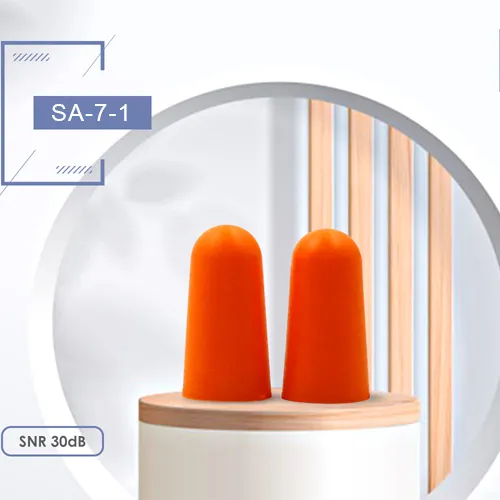
Foam ear plugs are the most widely used hearing protection device in the world. Made from slow-recovery polyurethane (PU) foam, they are rolled into a tight cylinder, inserted into the ear canal, and allowed to expand for a secure, comfortable seal.
- Typical NRR: 29–33 dB
- Best for: High-noise industrial environments, construction, manufacturing, general-purpose use
- Pros: Highest attenuation of any ear plug type; inexpensive; disposable (no cleaning required); lightweight
- Cons: Single-use generates more waste; may feel uncomfortable for some users; can muffle speech and warning signals
Foam ear plugs remain the workhorse of occupational hearing protection due to their unmatched noise reduction and low cost per pair. They are available in a variety of shapes — bullet, bell, T-shape, and contoured — to accommodate different ear canal sizes. Explore our classical bullet-shape PU foam ear plugs for an example of a high-performance disposable option.
For a detailed comparison of foam and silicone options, see our guide: Foam vs Silicone Ear Plugs: A Business Guide.
2. Silicone Ear Plugs (Reusable)
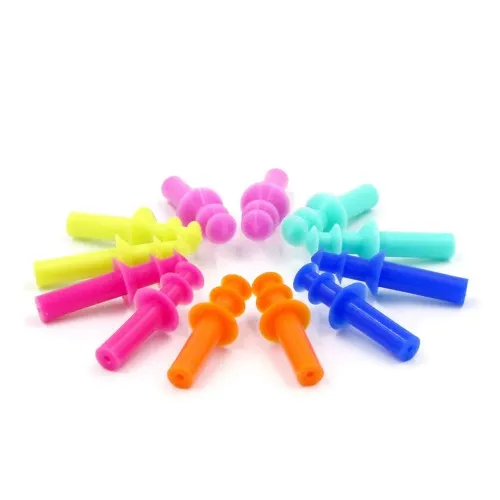
Reusable silicone ear plugs are made from medical-grade or industrial-grade silicone rubber. They feature a flanged or mushroom-tip design that creates a seal against the ear canal walls without the need for rolling or compression.
- Typical NRR: 22–27 dB
- Best for: Moderate-noise environments, repeated daily use, workers who prioritize comfort and sustainability
- Pros: Reusable (washable); more environmentally sustainable; consistent fit without roll-down technique; often includes a carrying case
- Cons: Slightly lower attenuation than premium foam plugs; requires regular cleaning; higher upfront cost per pair
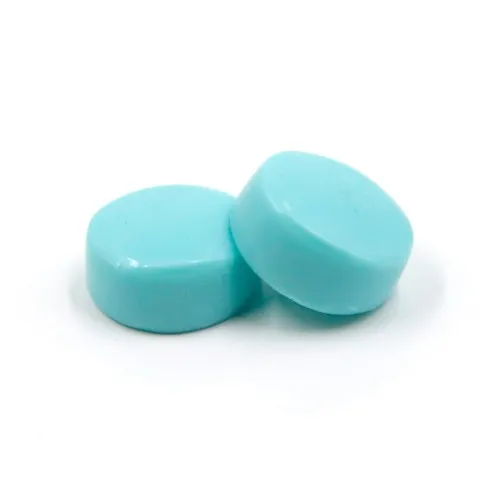
Silicone ear plugs are increasingly popular in workplaces that want to reduce disposable waste while maintaining reliable protection. Many designs include a detachable cord to prevent loss. Our silicone earplug range demonstrates the versatility of this material across applications.
3. Filtered Ear Plugs (High-Fidelity)
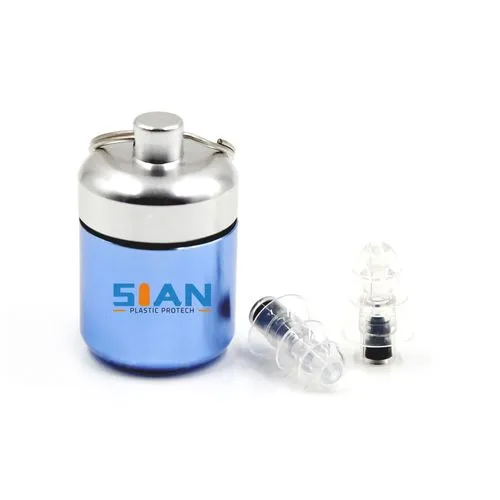
Filtered ear plugs — sometimes called high-fidelity or flat-attenuation ear plugs — incorporate a precision acoustic filter that reduces noise levels evenly across all frequencies. Unlike foam plugs that disproportionately block high-frequency sound, filtered plugs maintain the natural balance of the audio spectrum at a lower volume.
- Typical NRR: 12–20 dB (varies by filter)
- Best for: Musicians, concert venues, entertainment industry, communication-critical environments
- Pros: Preserves speech clarity and music quality; allows communication while still protecting hearing; interchangeable filters for different attenuation levels
- Cons: Lower overall attenuation; higher cost than foam or basic silicone plugs; not suitable for extremely high-noise environments
Filtered ear plugs are essential for professionals who need to hear clearly while being protected — musicians, sound engineers, bartenders, and dental hygienists are common users. View our standard filtered earplugs for a product designed with this application in mind.
4. Moldable Ear Plugs
Moldable ear plugs are made from thermoplastic silicone or similar materials that soften when warmed. The user shapes the plug to conform to their unique ear canal geometry, creating a semi-custom fit without the expense of a full custom impression.
- Typical NRR: 22–28 dB
- Best for: Users who struggle with standard-size plugs; environments requiring a personalized fit; multi-use applications
- Pros: Adapts to any ear canal shape; comfortable for extended wear; reusable
- Cons: Requires proper molding technique; more expensive than disposable options
Moldable plugs bridge the gap between universal and custom-fitted protection. They are an excellent choice for workers with unusually shaped ear canals or those who have difficulty achieving a seal with standard plugs. See our custom moldable silicone ear plugs for an example.
5. Banded Ear Plugs (Semi-Insert)
Banded ear plugs — also called canal caps or semi-insert plugs — consist of foam or silicone tips attached to a lightweight headband. The tips sit at the entrance of the ear canal rather than being inserted deeply.
- Typical NRR: 17–25 dB
- Best for: Intermittent noise exposure where plugs need to be frequently removed and replaced; workers moving between noisy and quiet zones
- Pros: Quick to put on and remove; stays around the neck when not in use; no deep insertion required
- Cons: Lower attenuation than deep-insert plugs; headband pressure can cause discomfort over long periods
Banded plugs are ideal for warehouse workers, quality inspectors, and supervisors who move in and out of noisy areas throughout the day.
6. Passive Ear Muffs
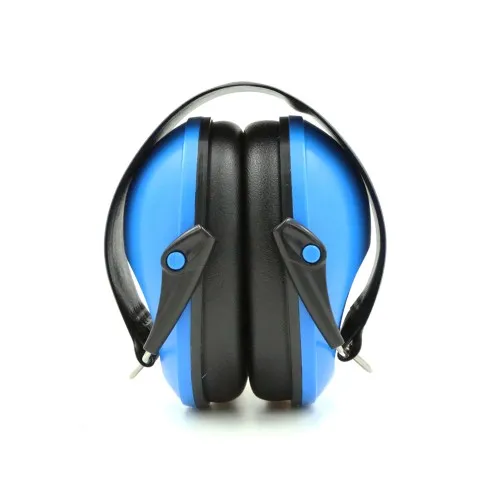
Passive ear muffs consist of rigid cups lined with acoustic foam, connected by an adjustable headband. They cover the entire external ear (pinna) to create a seal that blocks airborne noise.
- Typical NRR: 22–31 dB
- Best for: High-noise environments; users who dislike in-ear devices; cold-weather conditions; workplaces requiring quick donning/doffing
- Pros: Easy to put on and remove; one size fits most; visible compliance (supervisors can confirm workers are wearing them); no hygiene concerns related to ear canal insertion
- Cons: Heavier and bulkier; can cause heat buildup in warm environments; may interfere with safety glasses, hard hats, or other head-worn PPE
Passive ear muffs are the go-to choice for many construction sites, airports, and manufacturing facilities. Models with helmet-mount adapters are available for integration with hard hats. Explore our durable soundproof foldable earmuffs for a portable, high-performance option.
7. Electronic Ear Muffs
Electronic (active) ear muffs use built-in microphones and speakers to provide level-dependent protection. They amplify low-level ambient sounds — such as speech, warning signals, and machine alarms — while instantaneously compressing or clipping sounds that exceed a safe threshold (typically 82 dB).
- Typical NRR: 22–27 dB
- Best for: Shooting ranges, military/law enforcement, environments where situational awareness is critical, communication-intensive workplaces
- Pros: Allows normal conversation and hearing of warning signals; some models include Bluetooth, AM/FM radio, or two-way communication; automatic level-dependent compression
- Cons: Higher cost; requires batteries or charging; electronics add weight; not suitable for wet or extremely dusty conditions without IP-rated protection
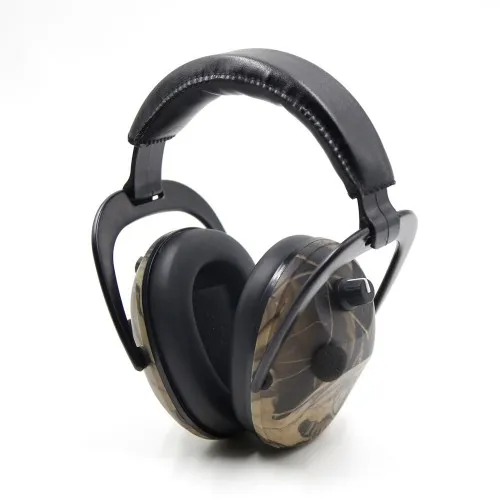
Electronic ear muffs represent the most advanced hearing protection technology available. They are indispensable in environments where blocking all sound would create a greater safety hazard than the noise itself. Our electronic active noise isolation ear muffs deliver level-dependent hearing protection with integrated audio features.
How to Choose the Right Hearing Protection
Selecting the right hearing protection device is not a one-size-fits-all decision. It requires balancing multiple factors to find the optimal solution for each specific environment and user. Here is a practical decision framework:
Step 1: Assess the Noise Environment
Start with an accurate noise assessment. Measure the time-weighted average (TWA) noise exposure for each job role, as well as peak noise levels. This data determines the minimum attenuation your hearing protectors must provide.
- 85–95 dBA: Most ear plugs or ear muffs will provide adequate protection. Foam plugs, silicone plugs, or standard ear muffs are all suitable.
- 95–105 dBA: High-attenuation foam ear plugs (NRR 30+) or premium ear muffs are recommended. Consider fit-testing to ensure adequate real-world attenuation.
- 105+ dBA: Dual protection (ear plugs combined with ear muffs) may be required. See the dual protection section below.
Step 2: Consider Exposure Duration and Pattern
- Continuous all-day exposure: Comfort is paramount. Choose lightweight foam plugs, ergonomic silicone plugs, or well-padded ear muffs that workers will actually wear for a full 8-hour shift.
- Intermittent exposure: Banded ear plugs or ear muffs that can be quickly removed and replaced are most practical. Workers are less likely to comply if donning and doffing is inconvenient.
- Impulse noise (gunshots, hammering, stamping): Electronic ear muffs with fast response times or high-NRR foam plugs are recommended.
Step 3: Evaluate the Work Environment
- Hot or humid conditions: Ear plugs are generally more comfortable than ear muffs in heat, as muffs trap moisture and warmth around the ears.
- Dusty or contaminated environments: Ear muffs may be preferred to avoid inserting contaminated fingers into the ear canal when using plugs. Alternatively, provide pre-rolled or encased foam plugs.
- Communication requirements: Filtered ear plugs or electronic ear muffs preserve speech intelligibility. Standard foam plugs significantly muffle speech.
- Need for situational awareness: Electronic ear muffs amplify ambient sounds below the threshold, maintaining awareness of warning signals and approaching vehicles.
Step 4: Check Compatibility with Other PPE
Hearing protection must work alongside the worker's other personal protective equipment:
- Hard hats: Standard headband muffs may not fit under or over a hard hat. Use helmet-mounted ear muffs instead.
- Safety glasses / goggles: The arms of safety glasses can break the seal of ear muff cushions, reducing attenuation by 5–10 dB. Consider thinner-profile ear muffs or use ear plugs instead.
- Respirators: Full-face respirators may interfere with ear muff headbands. Ear plugs are the better choice when wearing respiratory protection.
- Welding helmets: Similar interference issues as hard hats. Helmet-mounted muffs or ear plugs are the practical solution.
Step 5: Factor in User Preference and Compliance
The most important hearing protector is the one that workers will actually wear consistently. Even a device with a perfect NRR rating provides zero protection sitting in a pocket. Offer multiple options, provide proper training, and listen to worker feedback about comfort and fit. Browse the full EASTRAGON product catalog to see the range of options available for different workplace needs.
Understanding Noise Ratings: SNR vs NRR
When comparing hearing protection devices, you will encounter two primary rating systems. Understanding the difference is essential for accurate product selection and regulatory compliance.
NRR (Noise Reduction Rating)
The NRR is the rating system used in North America, defined by ANSI S3.19 or the newer ANSI S12.6 standard and regulated by the U.S. Environmental Protection Agency (EPA). It is expressed as a single number in decibels and represents the attenuation measured under laboratory conditions.
In practice, real-world attenuation is lower than the laboratory NRR. OSHA recommends derating the NRR by 50% for most planning purposes. For example, an ear plug with an NRR of 30 would provide an estimated real-world attenuation of approximately:
(30 - 7) / 2 = 11.5 dB (OSHA derating method for C-weighted noise measurements)
SNR (Single Number Rating)
The SNR is the rating system used in Europe and much of the rest of the world, defined by EN 352 and tested according to EN ISO 4869-2. Like the NRR, it is a single-number value expressed in decibels — but it is calculated differently and typically yields a higher number than the NRR for the same product.
The SNR system also provides H, M, and L values (High, Medium, and Low frequency attenuation), giving a more detailed picture of how the protector performs across the frequency spectrum. This is particularly useful when the dominant noise in a workplace is concentrated in a specific frequency range.
Key Differences
| Feature | NRR (ANSI) | SNR (EN) |
|---|---|---|
| Region | North America | Europe, Asia-Pacific, Middle East, Africa |
| Test standard | ANSI S3.19 / ANSI S12.6 | EN ISO 4869-1 / EN ISO 4869-2 |
| Test subject fit method | Experimenter-fit (S3.19) or subject-fit (S12.6) | Subject-fit |
| Number of test subjects | 10 | 16 |
| Typical value range (foam plugs) | 29–33 dB | 34–39 dB |
| Frequency detail | Single number only | Single number + H, M, L values |
Important: NRR and SNR values are not directly comparable. A product with an SNR of 37 dB does not provide more protection than a product with an NRR of 33 dB — they are simply measured and calculated differently. For a deep dive into the certification standards behind these ratings, read our guide on CE vs ANSI Certification for Ear Plugs.
Certifications and Standards
Hearing protection devices sold in regulated markets must meet specific certification requirements. Using non-certified products exposes employers to legal liability and puts workers at risk. Here are the three major certification frameworks:
CE Marking (Europe)
Products sold in the European Economic Area must carry the CE mark and comply with EU Regulation 2016/425 on Personal Protective Equipment. Hearing protectors are classified as Category II PPE and must be tested by a Notified Body to the EN 352 series of standards:
- EN 352-1: Ear muffs
- EN 352-2: Ear plugs
- EN 352-3: Helmet-mounted ear muffs
- EN 352-4 to 352-8: Level-dependent and electronic devices
CE certification requires EU-type examination by an accredited Notified Body, ongoing factory production control, and the issuance of an EU Declaration of Conformity. This is the most commonly requested certification for hearing protection products worldwide.
ANSI Standards (United States)
In the U.S., hearing protection devices must be tested according to ANSI S3.19-1974 or the newer ANSI/ASA S12.6-2016 standard and labeled with an NRR per EPA regulation 40 CFR Part 211. While ANSI certification is not a "mark" in the same way as CE, compliance with ANSI standards is effectively mandatory for products sold in the U.S. market.
AS/NZS 1270 (Australia/New Zealand)
Products sold in Australia and New Zealand must comply with AS/NZS 1270:2002. This standard specifies requirements and test methods for hearing protectors, and its classification system (Class 1 through Class 5) provides an intuitive guide to the level of protection offered.
For a comprehensive comparison of these certification systems, visit our CE vs ANSI Certification Guide. You can also learn more about our quality management processes on our Quality Assurance page.
Proper Fit and Use
Even the highest-rated hearing protector is only effective if it fits correctly and is worn consistently. Studies consistently show that real-world attenuation is significantly lower than laboratory ratings, primarily due to improper fit. A well-fitted NRR 25 plug can outperform a poorly fitted NRR 33 plug in practice.
How to Insert Foam Ear Plugs Correctly
- Clean your hands. Dirt and oils can degrade the foam and introduce contaminants into the ear canal.
- Roll the plug. Using clean, dry fingers, roll the entire ear plug into the thinnest, most crease-free cylinder possible. Roll slowly and evenly — do not fold or crumple.
- Pull back the ear. With the opposite hand, reach over the top of your head and pull the top of your ear (pinna) upward and outward. This straightens the ear canal and opens it for insertion.
- Insert deeply. Quickly slide the rolled plug into the ear canal. The plug should be inserted deep enough that it cannot be seen when looking directly at the person from the front. If using a mirror, you should not be able to see the plug when looking straight ahead.
- Hold in place. Hold the plug gently with your fingertip for 30–45 seconds while the foam expands and fills the ear canal. Do not push further — just prevent it from backing out as it expands.
- Verify the fit. Sounds around you should be noticeably muffled. Cup your hands over your ears — if the noise level drops significantly when you cover your ears, the plugs are not seated deeply enough and should be reinserted.
How to Insert Silicone / Flanged Ear Plugs
- Clean your hands and the plug. Wash both before each use.
- Pull back the ear. Same technique as above — reach over the head, pull the pinna upward and outward.
- Insert with a gentle rocking motion. Do not force the plug. Use a slight twisting or rocking motion to advance the flanges into the ear canal until a comfortable seal is achieved.
- Check the seal. You should feel a slight suction and notice a reduction in ambient sound. Some users find it helpful to open and close their jaw to help the plug settle into position.
Fit Testing
Personal fit testing systems — such as those using microphone-in-real-ear (MIRE) or field attenuation estimation systems (FAES) — measure the actual attenuation each worker achieves with their specific ear plugs. Fit testing identifies workers who are not achieving adequate protection and allows targeted retraining or product changes.
Many occupational health professionals now recommend annual fit testing as part of a comprehensive hearing conservation program.
Common Fit Mistakes
- Not rolling foam plugs tightly enough — results in a loose fit and dramatically reduced attenuation
- Inserting too shallow — the most common error; the plug should be deeper than most people initially expect
- Not pulling the ear back — skipping this step prevents the ear canal from opening fully
- Handling with dirty or wet hands — contaminates the plug and can cause ear infections
- Reusing disposable foam plugs — compressed foam loses its recovery properties, and accumulated dirt creates hygiene risks
- Wearing ear muffs over thick hair or hats — breaks the cushion seal and can reduce attenuation by 5–15 dB
Dual Protection: When Plugs + Muffs Are Necessary
In environments where noise levels exceed 100–105 dBA, a single hearing protection device — even one with the highest available rating — may not provide sufficient attenuation. In these situations, dual protection is recommended: wearing ear plugs underneath ear muffs simultaneously.
It is important to understand that dual protection does not simply add the ratings together. Wearing an NRR 33 plug under an NRR 27 muff does not yield NRR 60 protection. The combined real-world benefit is typically an additional 5–10 dB beyond the higher-rated device alone. OSHA's calculation method is:
Combined NRR = Higher NRR + 5 dB
Dual protection is commonly required in the following environments:
- Metal stamping and forging operations
- Jet engine maintenance and aircraft carrier decks
- Mining with heavy drilling equipment
- Indoor shooting ranges
- Pile driving operations
- Certain textile manufacturing processes
When specifying dual protection, choose ear plugs that are comfortable for all-day wear (since they will be in constant contact with the ear canal) and ear muffs that do not create excessive heat or headband pressure. Foam ear plugs combined with a well-padded passive ear muff is the most common and effective combination.
Hearing Conservation Programs
In most regulatory jurisdictions, employers are required to implement a formal Hearing Conservation Program (HCP) when worker noise exposure meets or exceeds the action level (85 dBA TWA under OSHA, 80 dBA under EU directive). A complete HCP includes the following elements:
1. Noise Monitoring
Conduct baseline and periodic noise surveys using calibrated sound level meters and dosimeters. Identify all areas and job roles where exposure exceeds the action level. Document results and make them available to affected workers.
2. Audiometric Testing
Provide baseline and annual audiometric tests for all workers in the hearing conservation program. Audiograms must be conducted by a qualified audiologist or trained technician using calibrated audiometers. Compare annual results against the baseline to detect any standard threshold shift (STS) early.
3. Engineering and Administrative Controls
Before relying on hearing protection devices, employers should implement feasible engineering controls (sound barriers, vibration damping, equipment maintenance, isolation enclosures) and administrative controls (job rotation, scheduling noisy tasks during low-occupancy periods) to reduce noise at the source.
4. Hearing Protection Device Selection and Provision
Provide a range of suitable hearing protectors at no cost to workers. Allow workers to choose the style that fits them best and is most comfortable — compliance depends on comfort and personal preference. Ensure devices are properly rated for the noise exposure level.
5. Training and Education
Train workers annually on the effects of noise on hearing, the purpose and use of hearing protectors, proper insertion and fit techniques, and the purpose of audiometric testing. Training should be practical, hands-on, and documented.
6. Recordkeeping
Maintain accurate records of noise exposure measurements, audiometric test results, hearing protector assignments, and training documentation. OSHA requires retention of audiometric records for the duration of employment.
7. Program Evaluation
Review the program annually to identify areas for improvement. Analyze audiometric data trends, investigate any threshold shifts, assess worker compliance, and update protector selections as needed.
A well-executed hearing conservation program is not just a regulatory obligation — it is an investment in workforce health, productivity, and retention. EASTRAGON partners with distributors and safety managers to provide the products and technical support needed for effective hearing conservation programs.
Sourcing Hearing Protection: OEM and ODM Solutions
For distributors, brand owners, and large-volume buyers, sourcing hearing protection from a reliable manufacturer is a critical business decision. The global hearing protection market is dominated by products manufactured in China, where mature supply chains, competitive pricing, and extensive OEM/ODM capabilities make it the preferred sourcing destination for buyers worldwide.
OEM vs ODM: What's the Difference?
- OEM (Original Equipment Manufacturing): The manufacturer produces products to your specifications. You own the design, branding, and packaging. The factory executes production according to your requirements.
- ODM (Original Design Manufacturing): The manufacturer offers their own proven product designs, which you can brand and package under your label. This is faster and less expensive than full custom OEM, as it leverages existing molds and tooling.
Key Considerations When Sourcing
- Certifications: Ensure the factory can supply products with valid CE, ANSI, or other certifications required by your target market. Ask for copies of test reports and certificates — and verify them with the issuing Notified Body.
- Minimum Order Quantities (MOQ): MOQs vary widely by product type. Foam ear plugs may have MOQs of 50,000–100,000 pairs; silicone plugs are typically 3,000–10,000 pairs; ear muffs may start at 1,000–3,000 units.
- Customization capabilities: Evaluate the factory's ability to customize colors, shapes, packaging, labeling, and acoustic performance to your specifications.
- Quality control processes: Look for factories with ISO 9001 certification, in-house testing laboratories, and documented quality inspection procedures.
- Communication and responsiveness: A manufacturer with an English-speaking sales team and experience serving international clients will be significantly easier to work with.
For a step-by-step guide to launching your own branded ear plug line, read How to Start Your Own Ear Plug Brand. For a detailed checklist of what to evaluate when selecting a PPE supplier from China, see Top Criteria for Choosing a PPE Supplier in China.
EASTRAGON offers both OEM and ODM services across the full range of hearing protection products — from disposable foam ear plugs and reusable silicone plugs to electronic ear muffs. Visit our product catalog to explore available product lines, or contact our team to discuss your requirements.
Frequently Asked Questions
How do I know if my ear plugs fit properly?
A properly fitted ear plug should feel snug but not painful, and you should notice a significant reduction in ambient noise. The "hand cup" test is a quick field check: with plugs inserted, cup your hands tightly over your ears. If covering your ears causes a large additional drop in noise, the plugs are not sealed properly and need to be reinserted more deeply. For more reliable results, personal fit testing using MIRE or FAES equipment gives a quantitative measurement of the actual attenuation you are achieving.
What is the difference between NRR and SNR ratings?
NRR (Noise Reduction Rating) is the rating system used in North America under ANSI standards, while SNR (Single Number Rating) is used in Europe and most other markets under EN standards. Both express attenuation in decibels, but they are calculated using different test methods and different statistical approaches. SNR values tend to be numerically higher than NRR values for the same product — this does not mean the product performs better in Europe. The two numbers are simply not directly comparable. For details, see our CE vs ANSI certification guide.
How often should I replace my ear plugs?
Disposable foam ear plugs should be used once and then discarded. Do not wash or reuse them — the foam degrades after compression and loses its ability to seal. Reusable silicone ear plugs should be cleaned after each use and replaced when they show signs of hardening, cracking, shrinkage, or loss of flexibility — typically every 2 to 4 weeks with daily use, though some premium models last several months. Ear muff cushions and foam liners should be replaced every 6 to 12 months, or sooner if they become stiff, cracked, or no longer make a complete seal around the ear.
Are there hearing protectors suitable for children?
Yes. Children have smaller ear canals and heads, so adult-sized ear plugs and ear muffs typically do not fit properly. Purpose-designed children's ear muffs are available with smaller cups and lighter headband tension. For ear plugs, small-sized foam or silicone plugs can work for older children, but ear muffs are generally recommended for younger children because they are easier to use correctly and parents can visually confirm they are being worn. Hearing protection is important for children at concerts, sporting events, motor racing, and when using power tools or lawnmowers.
Can I use ear plugs for sleeping?
Ear plugs are widely used for sleep improvement, particularly by shift workers, travelers, and people living in noisy urban environments. Soft foam ear plugs and low-profile silicone plugs are the most comfortable options for side-sleepers. Look for plugs with a smooth, tapered shape that does not protrude significantly from the ear canal. It is important to use clean plugs each night and to replace disposable plugs daily to maintain hygiene. Moldable wax or silicone putty plugs are another popular option for sleeping, as they conform to the outer ear without deep canal insertion.
Can I swim with ear plugs?
Standard industrial ear plugs are not designed for swimming and may not create a reliable waterproof seal. Purpose-designed swimming ear plugs — typically made from silicone or moldable materials — are engineered to keep water out of the ear canal. They are especially recommended for individuals prone to swimmer's ear (otitis externa) or those with ear tubes. When sourcing swimming ear plugs, look for products specifically tested and marketed for aquatic use rather than repurposing industrial hearing protection.
When should I wear both ear plugs and ear muffs at the same time?
Dual protection — wearing ear plugs under ear muffs simultaneously — is recommended when noise exposure exceeds 100–105 dBA, or whenever a single device cannot reduce exposure to safe levels on its own. Common scenarios include metal stamping, indoor shooting ranges, jet engine maintenance, and pile driving. Remember that the combined protection is not the sum of both ratings; OSHA's simplified calculation adds 5 dB to the higher-rated device's NRR to estimate dual-protection attenuation.
Are custom-molded ear plugs better than universal-fit plugs?
Custom-molded ear plugs — made from impressions of the individual's ear canal — offer an excellent, repeatable fit and are very comfortable for extended wear. However, they are not inherently "better" in terms of attenuation. A well-fitted universal foam plug can match or exceed the noise reduction of a custom mold. The primary advantages of custom plugs are consistency of fit (no variability from insertion technique), long-term comfort, and reduced ongoing cost over time since they last for years. The disadvantage is higher upfront cost. For most industrial applications, properly fitted universal plugs provide excellent protection at a fraction of the cost. Custom molded plugs are most valuable for workers who use hearing protection daily for extended hours, or for users with ear canal shapes that make universal plugs difficult to fit.
Find the Right Hearing Protection for Your Needs
Whether you are sourcing hearing protection for your workforce, building a private-label brand, or looking for an OEM manufacturing partner, EASTRAGON provides a comprehensive range of certified ear plugs and ear muffs backed by over a decade of manufacturing expertise.